.png)
Why scale, speed, and profitability finally stopped being trade-offs
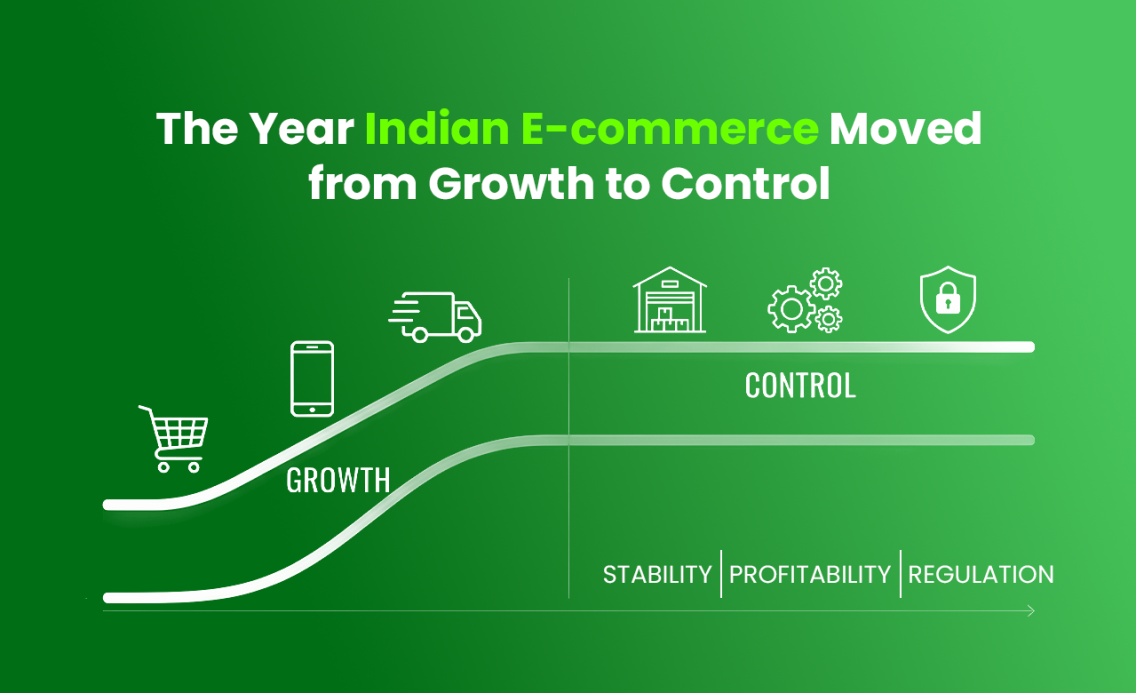
For much of the last decade, Indian e-commerce followed a familiar rhythm: chase growth, absorb volatility, fix margins later. Scale was celebrated. Control was optional.
2025 marked a decisive break from that playbook.
As highlighted in EasyEcom’s 2025 E-Commerce Collective, the industry crossed a structural threshold — one where scale and operational discipline began to coexist. The ecosystem processed nearly ₹278 billion in GMV while growing order volumes 67% year-on-year, without the operational fragility that once defined high-growth years.
This shift wasn’t accidental. It was the outcome of years of infrastructure investment, data maturity, and a hard-earned understanding that growth without control is no longer viable.
From Festive Spikes to a High-Velocity Plateau
Historically, Indian e-commerce was built around volatility. Q4 — especially a 10–15 day festive window — carried disproportionate revenue and risk.
In 2025, that dependency finally loosened.
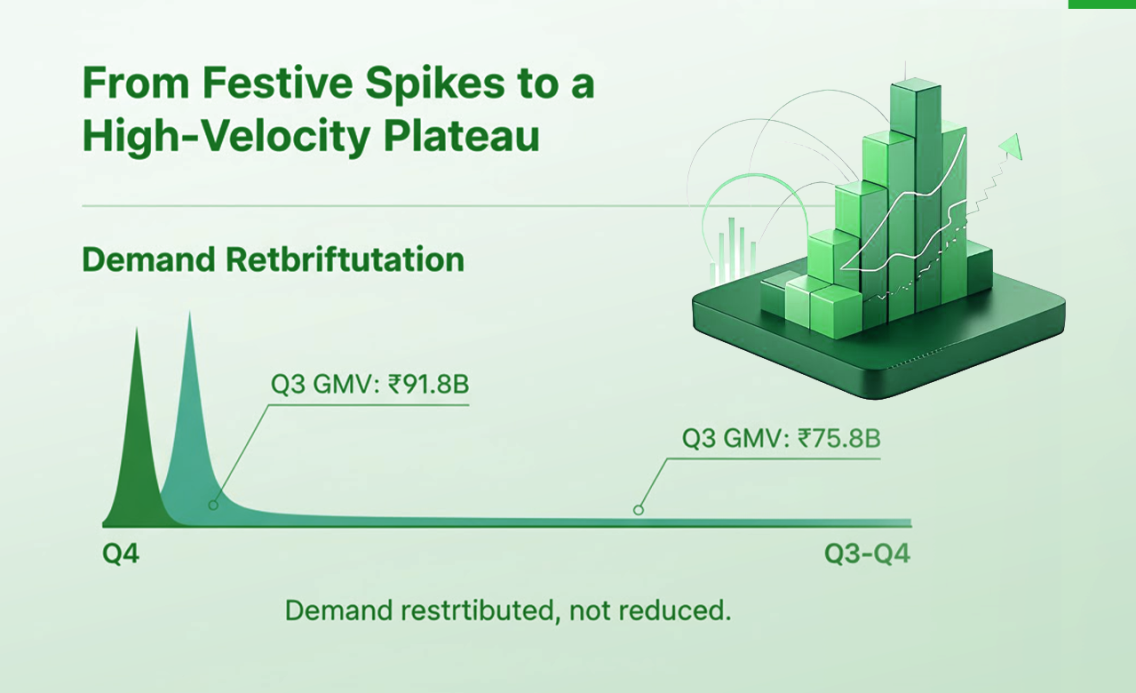
EasyEcom’s data shows Q3 (July–September) overtaking Q4 in GMV contribution, with ₹91.8 billion processed in Q3, compared to ₹75.8 billion in Q4. Demand didn’t disappear — it redistributed.
This aligns closely with broader global observations.
A McKinsey Global Institute study on digital commerce maturity notes that advanced markets increasingly shift from “event-driven spikes” to extended demand curves, reducing peak-load risk and improving inventory economics.
In India, that transition is now visible.
Festive readiness is no longer a September scramble. It’s a July discipline.
The result is a new operating baseline — what can best be described as a high-velocity plateau: sustained throughput, fewer cliffs, and far greater predictability.
Returns: The Industry’s Quiet Profit Breakthrough
Few metrics have drained more margin from Indian e-commerce than returns.
BCG has repeatedly estimated that returns can erode 15–25% of gross margins in fashion-led e-commerce if left unmanaged. For years, they were treated as an unavoidable cost of scale.
2025 challenged that assumption.
According to the report, return rates dropped from 24.8% in Q4 2024 to 16.2% in Q4 2025 — a 40% improvement at ecosystem scale.
What changed?
Not consumer behavior alone, but system design:
- Better shipment verification
- Category-specific QC rules
- Faster reconciliation and dispute resolution
- Tighter inventory accuracy at dispatch
Beauty and personal care brands led the way, with sub-10% returns, while fashion — still structurally higher — became the focal point for operational innovation rather than resignation.
Returns, once seen as a tax on growth, are now increasingly viewed as a controllable variable
Speed as a Trust Metric, Not a Differentiator
As volumes surged, fulfillment speed didn’t deteriorate — it improved.
The ecosystem’s average click-to-ship time dropped by 52%, reaching 7.4 hours, with peak periods in December seeing shipments dispatched in as little as 1.5 hours.
This aligns with a broader global trend.
McKinsey’s Future of Fulfillment research notes that consumers increasingly interpret delivery speed as a proxy for brand reliability, not convenience.
In that context, speed is no longer a growth lever.
It is a trust signal.
The Most Underrated Win: Zero Dead Stock
Perhaps the most telling indicator of operational maturity in 2025 was inventory discipline.
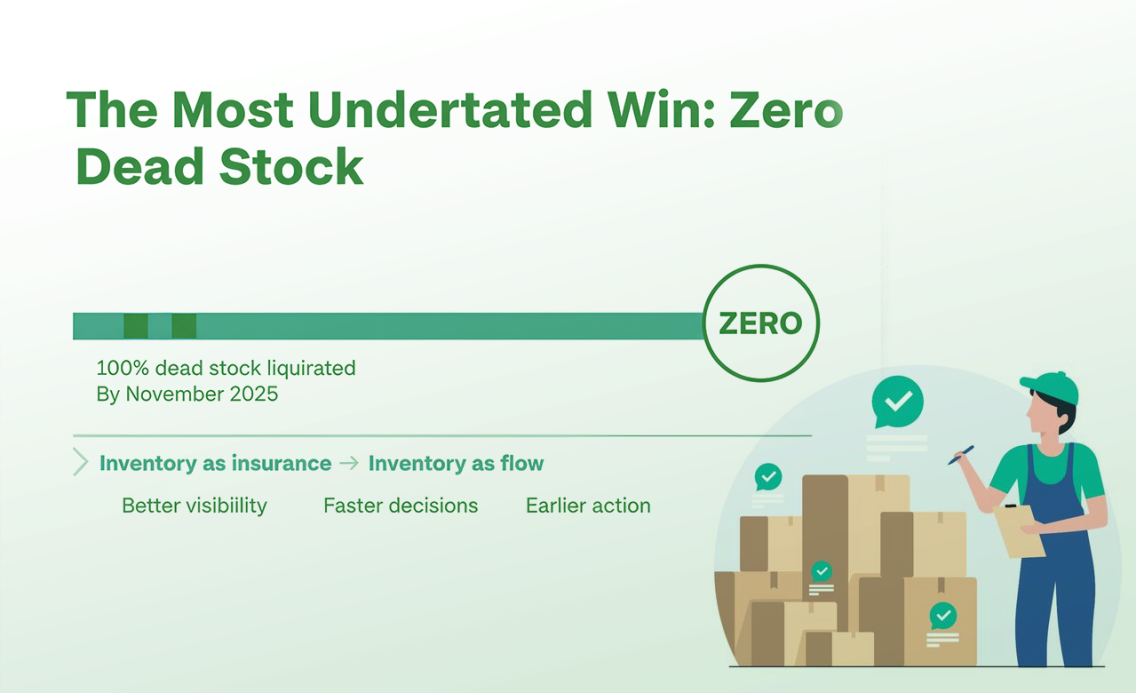
The ecosystem achieved 100% liquidation of dead stock by November, freeing working capital and entering the new year without legacy drag.
In BCG’s language, this reflects a shift from “inventory as insurance” to inventory as flow — where capital moves continuously rather than sitting idle.
This didn’t happen because brands sold more aggressively.
It happened because they saw better, decided faster, and acted earlier.
What 2025 Ultimately Proved
If there is one lesson 2025 made unmistakably clear, it is this:
Growth at scale is no longer a function of effort.
It is a function of systems.
The brands that outperformed weren’t necessarily louder or leaner.
They were better engineered.
They built for:
- Sustained velocity, not spikes
- Control, not heroics
- Intelligence, not intuition
Indian e-commerce didn’t just grow up in 2025.It professionalized.

Explore the Full Report
This article captures only a fraction of the insights.
The 2025 E-Commerce Collective dives deeper into:
- Quarterly GMV and demand curve shifts
- Category-wise return benchmarks
- Channel-specific growth dynamics
- Regional fulfillment strategy
- The operational principles shaping 2026
👉 Download the full report to see how the industry’s highest-performing commerce ecosystem actually runs.